
Straight answers to common questions.
Forge is designed to be understood through customer-visible outcomes, boundaries, proof and economics without disclosing protected proprietary optimization methods.
The questions below cover the operating model, commercial structure, security posture and current product boundaries that usually matter first in a customer conversation.
Frequently asked questions
Expanded from the Forge Field Guide. The answers below summarize the operating model, commercial approach, customer control and current boundaries in one place.
What is Forge Intelligence Layer?
Forge is an independent AI intelligence and optimization layer for eligible enterprise AI workloads. Its immediate commercial objective is to reduce inference expenditure while preserving required outcome quality and customer control.
Is Forge an AI provider or model?
No. The underlying AI provider still performs the inference. Forge is the independent layer around eligible workload economics, governance and measurement.
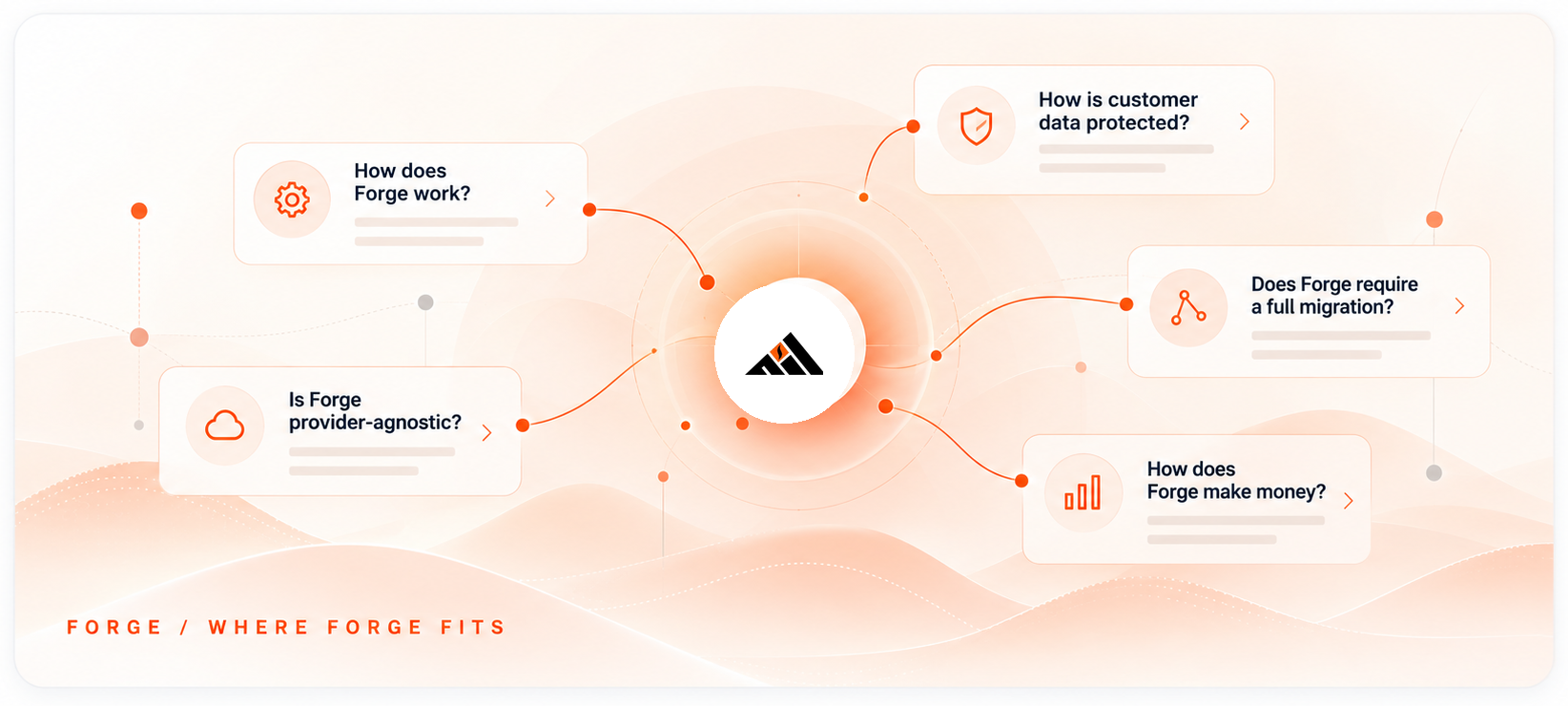
Is Forge provider-agnostic?
Forge is designed to operate independently of any single provider. Actual provider support and approved model/deployment choices are confirmed during customer onboarding.
Does the customer give Forge its main provider account?
No. The customer retains ownership of its provider relationship. Forge uses customer-scoped, approved access rather than pooling customers into one shared provider identity.
Does Forge require a complete migration?
No. The standard objective is to introduce Forge around agreed eligible activity while preserving the customer’s existing environment and provider relationship.
How does Forge make money?
The primary commercial model is shared savings. The customer retains the majority of verified savings and Forge receives the agreed contractual share.
How are savings verified?
Savings are measured against an agreed customer no-Forge baseline on the existing provider pathway. Only evidenced savings are treated as shareable.
Does Forge guarantee a percentage of savings?
No. Savings depend on the customer’s workloads, existing baseline, provider economics and usage patterns.
Does Forge use cheaper models to create savings?
Forge is not sold as a model-downgrade strategy. Required outcome quality and customer-approved model/provider boundaries remain constraints.
Is Forge built on a third-party optimizer?
No. Forge’s optimization and governance layer is proprietary. Standard cloud infrastructure and customer-approved AI providers are external dependencies, but they are not a hidden third-party Forge substitute.
Does Forge store prompts and responses in its normal audit logs?
Forge’s evidence architecture is designed to minimize sensitive-content replication and does not rely on routinely placing prompt and response bodies into normal operational evidence stores.
Where does customer context live?
Forge’s architecture favors governed access to customer-owned source systems rather than indiscriminately copying customer repositories into a Forge-controlled data lake.
Can Forge handle agentic AI?
Agentic environments require additional qualification because autonomous actions, tools, retries, external systems and approval boundaries can materially change workflow and inference requirements.
What happens if a workload is not a good fit?
Forge can leave it outside standard scope and/or escalate it for custom technical review. Forge does not force unsuitable workloads into the product.
What happens if a customer has multiple AI providers?
Forge is designed to accommodate multiple approved AI providers per customer, subject to provider availability and integration support confirmed during onboarding.
Can Forge work with private or open-weight models?
Potentially, where the model is exposed through an approved controllable interface and meets the customer’s security and integration requirements. Specific support requires technical review.
Will Forge change the customer’s application?
The standard objective is minimal disruption, but some environments may require agreed integration work. Custom work is scoped and approved before commencement.
Can the customer see what Forge is doing?
Forge is designed around customer-visible status, evidence and economics without exposing protected Forge IP. Exact surfaces depend on the approved customer release.
What protects one customer from another?
Forge uses explicit tenant identity, customer-scoped credentials, isolation controls and cross-customer validation.
Can a customer stop using Forge?
Yes. Forge is designed to avoid forcing the customer to surrender its underlying provider relationship. Contractual termination and switch-over procedures follow the customer agreement and approved deployment.
Does Forge provide its algorithm for inspection?
Forge’s internal optimization methods are proprietary. Customers evaluate the measurable result, agreed quality, security posture and economics rather than protected optimization IP.
See where Forge could fit your AI environment.
Start with a high-level qualification conversation. No sensitive or confidential information is required.