
Bounded authority
Forge should receive only the authority required for the approved task.
Forge began as work on AI safety and alignment, asking how increasingly capable intelligence could operate more coherently, accountably and sustainably over time.
The commercial system does not present abstract alignment philosophy as a customer claim. It carries forward concrete operating principles that shape authority, quality, continuity, evidence and resource discipline.
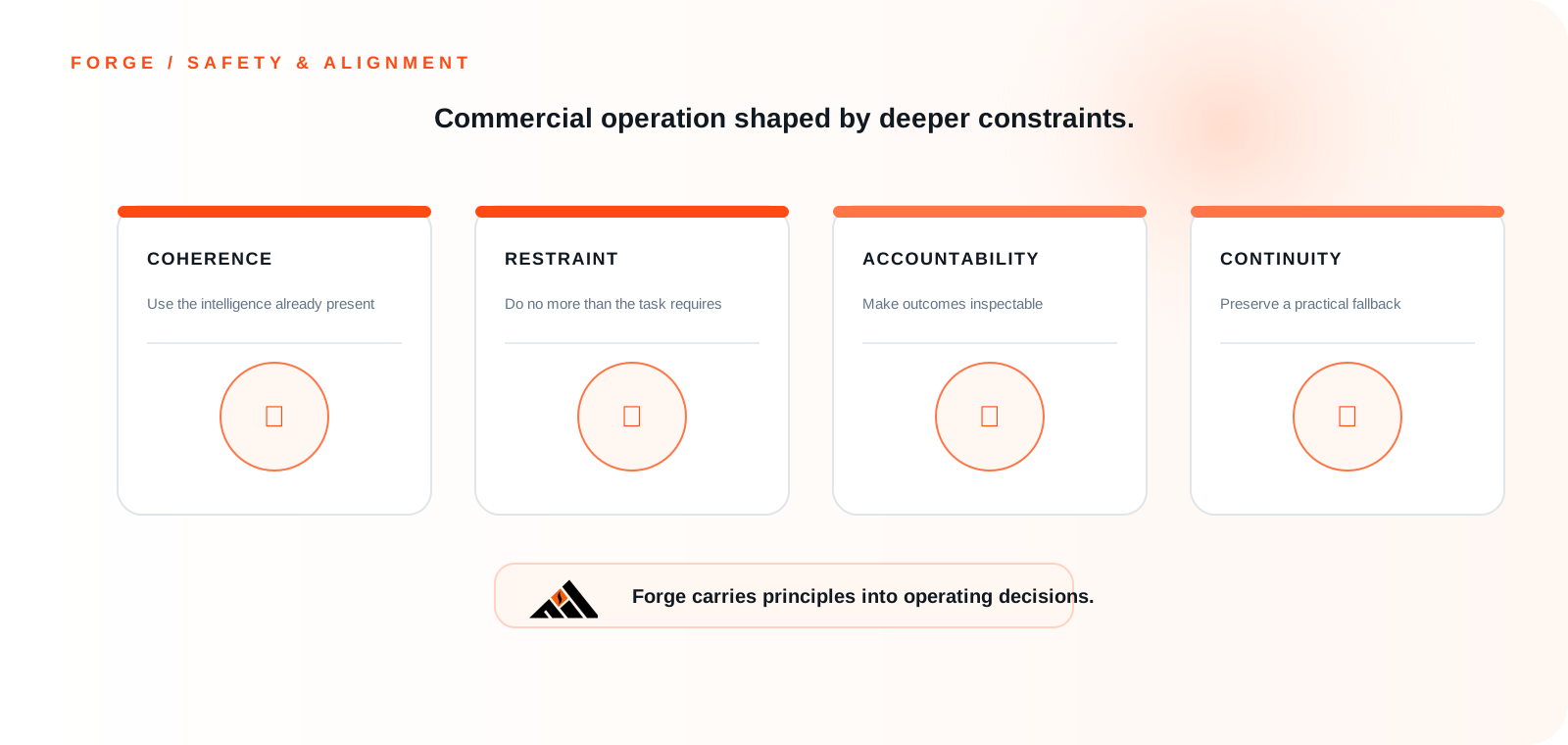
The work began from the view that external safeguards, governance and model-level alignment are important, but should be complemented by deeper architectural principles around coherence, restraint, accountability and continuity.
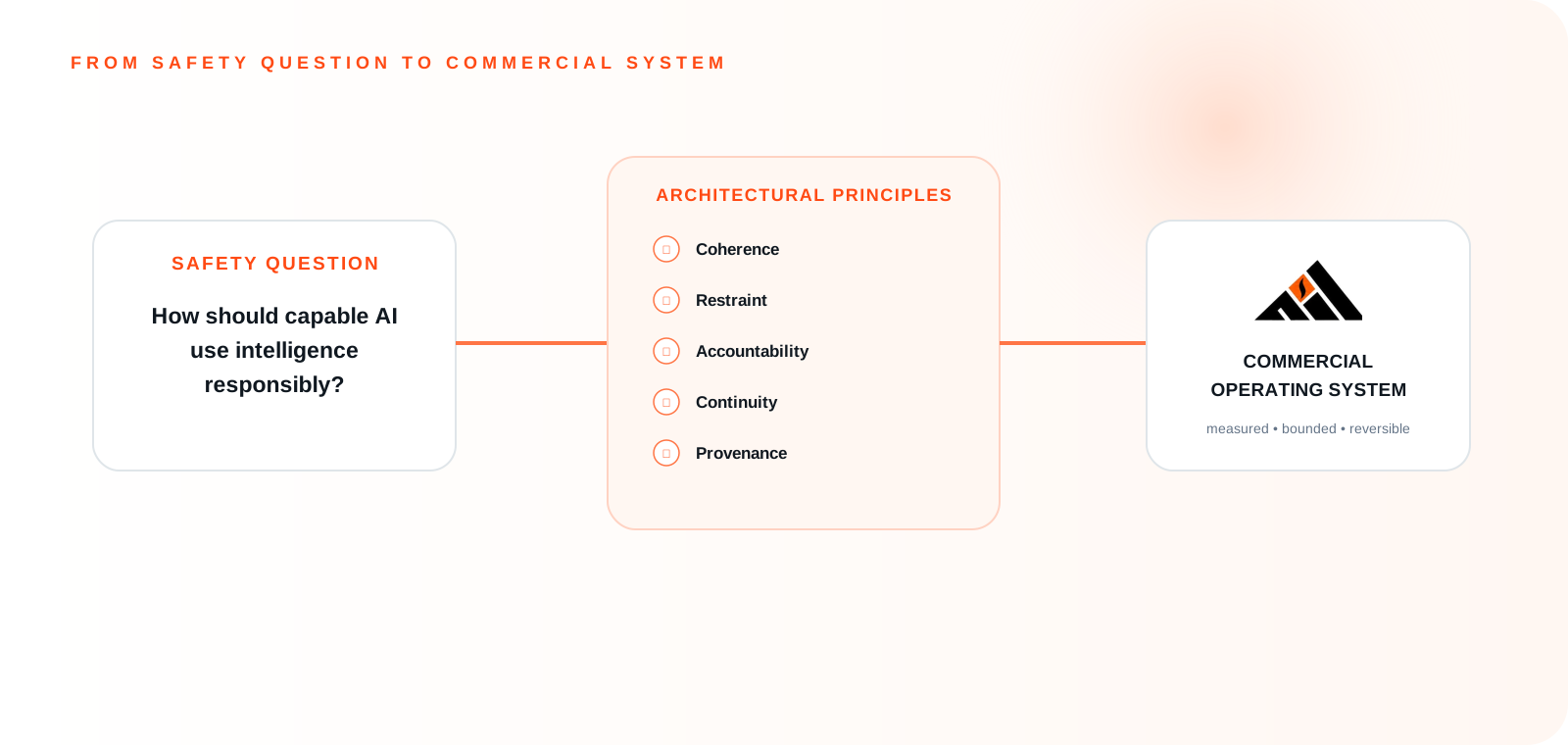
The same principles show up as practical product decisions. Bounded authority, reversibility, required quality, provenance and accountability become concrete operating requirements rather than abstract principles.
Forge should receive only the authority required for the approved task.
The customer retains provider ownership and workflow decisions.
The existing path remains available as a practical fallback.
Savings do not override the accepted business result.
Proof is measured against a real customer baseline.
Use only the resources required for the accepted outcome.
Service continuity remains a design obligation.
Evidence should preserve what happened and under which authority.
Commercial value is tied to customer-visible evidence.
Start with a high-level qualification conversation. No sensitive or confidential information is required.