
Sensitive-content minimization
Operational telemetry and audit evidence are designed to avoid routine copying of prompt and response bodies.
Evidence focuses on customer-safe metadata and proof rather than duplicated content.
Forge is designed to avoid becoming a duplicate enterprise data lake. Where customer context is required, the preferred pattern is governed access to customer-controlled source repositories.
The privacy model is designed around purpose-bound access and minimizing unnecessary replication. Customer source information should remain in customer-controlled systems wherever the approved integration permits.
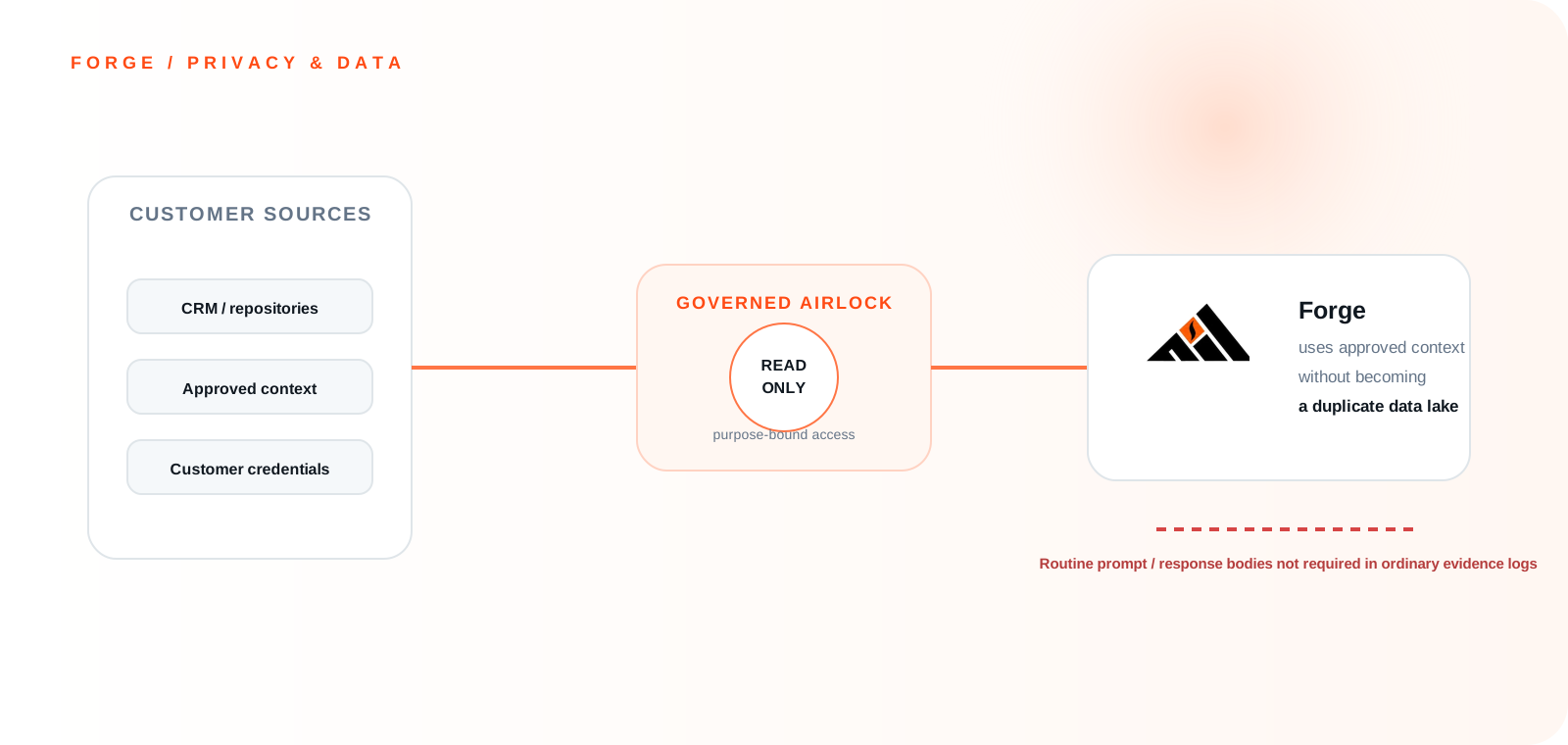
Each principle links a privacy objective to an operating control. Together they reduce unnecessary content replication, limit access to approved purposes and preserve customer revocation authority.
Operational telemetry and audit evidence are designed to avoid routine copying of prompt and response bodies.
Evidence focuses on customer-safe metadata and proof rather than duplicated content.
Context credentials can be tenant-scoped and read-only where supported.
Access is limited to the approved purpose and workflow rather than a broad standing entitlement.
Customer repository and provider access can be revoked during offboarding.
Source information remains in customer systems, and the customer can close access.
Forge favors governed access to customer-owned repositories instead of indiscriminately copying enterprise knowledge into a Forge-owned data lake.
Start with a high-level qualification conversation. No sensitive or confidential information is required.