
Security & Trust
Security without requiring blind trust.
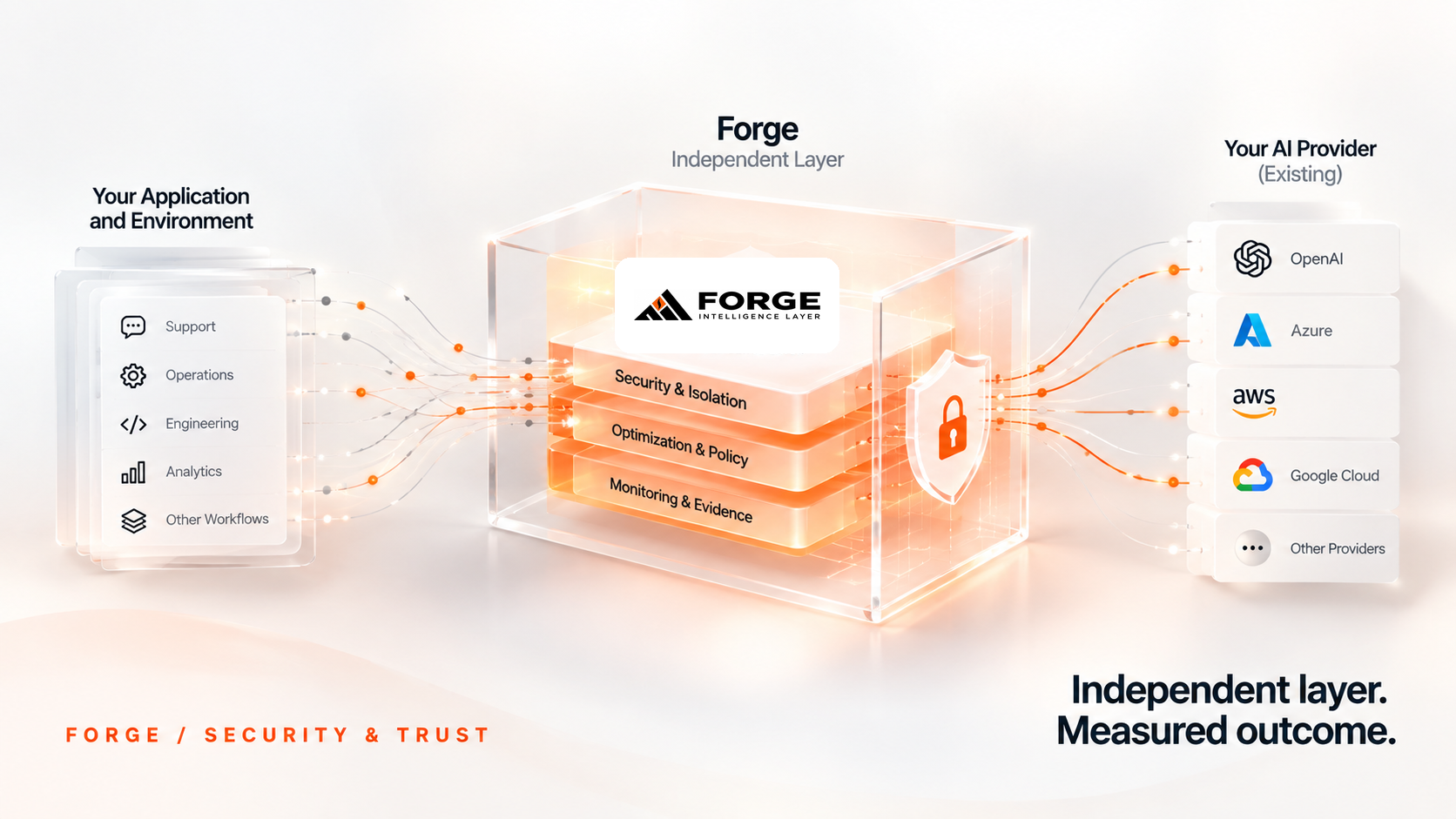
Forge operates in a sensitive part of the enterprise AI pathway. The security model is built around bounded authority, customer isolation, protected credentials, minimized sensitive-content replication and preserved customer control.
Security is expressed as operating boundaries the customer can understand: whose data, whose credentials, which workflow, which authority, what evidence and what happens when access is removed.
A bounded trust model
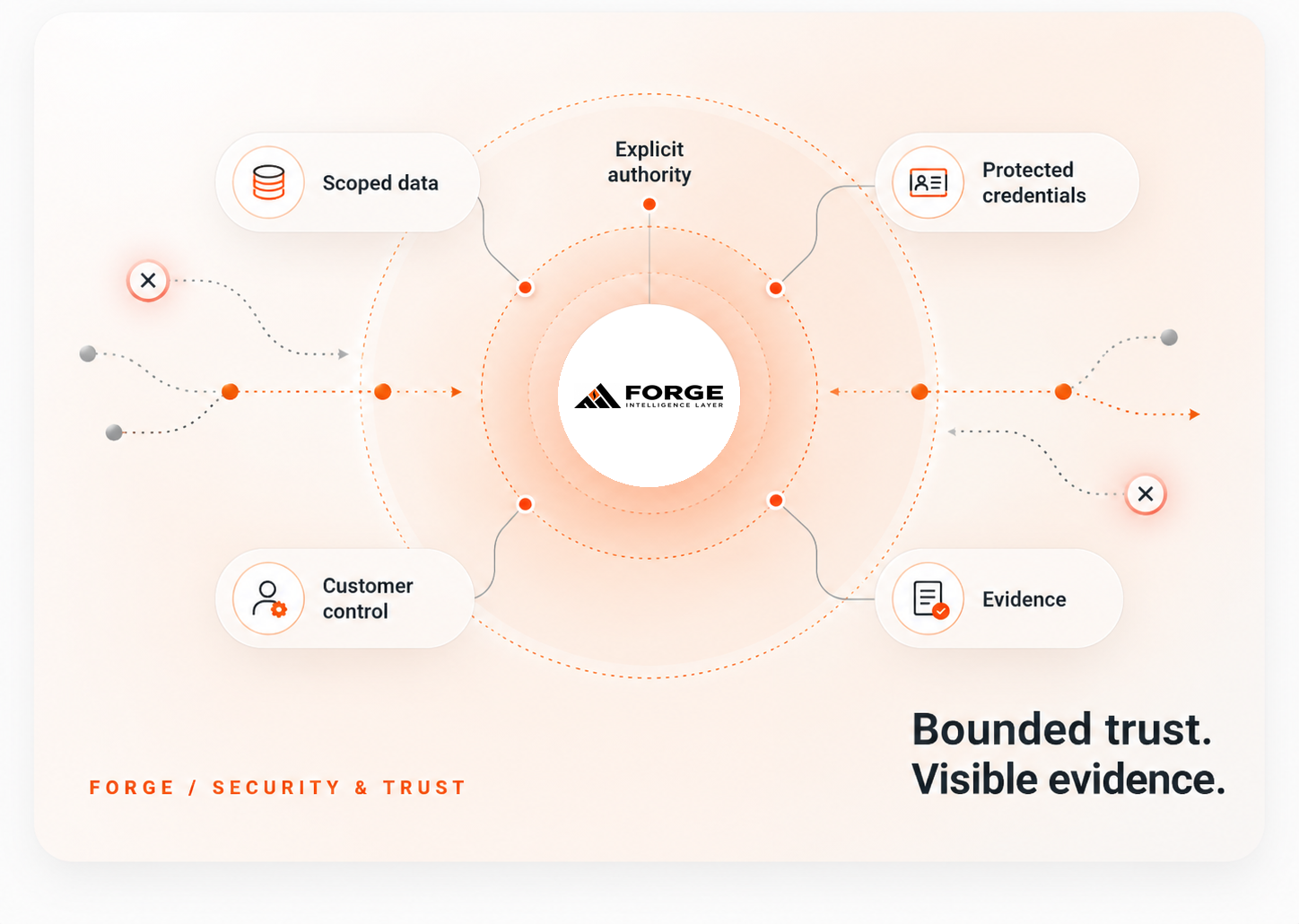
Forge is designed to reduce the amount of blind trust required by keeping customer authority explicit and evidence visible.
Forge participates in the intelligence path without requiring unrestricted authority over the customer environment. Access can remain bounded to the approved workload and purpose, while the customer's existing provider relationship remains available as a preserved path.
Customer context should be exposed only where it is required for the authorized transaction. Where the integration permits, credentials can be tenant-scoped and read-only, and customer-controlled source information can remain in customer systems rather than being routinely copied into Forge.
Security posture
Evidence without indiscriminate retention.
Forge's evidence model is intended to preserve accountability without indiscriminate content retention. Operational proof can focus on customer-safe metadata, measured outcomes and auditable decisions rather than routinely reproducing prompt and response bodies into ordinary logs.
The objective is not to ask customers to trust Forge more. It is to reduce the amount of blind trust the architecture requires.
Three customer-facing protections
The core principles remain understandable without exposing protected implementation details. Tenant isolation, customer-scoped access and bounded operational authority are presented as practical controls rather than as vague assurances.
Your data stays scoped
Forge accesses only the customer, workflow and context authorized for the approved task. Tenant boundaries keep customer authority separated.
Your credentials stay protected
Provider and context credentials are held in managed secret systems rather than embedded in code, ordinary configuration or normal logs.
Your provider remains yours
Customers retain ownership of provider relationships, credentials and billing visibility rather than being pooled into one shared provider identity.
Next step
See where Forge could fit your AI environment.
Start with a high-level qualification conversation. No sensitive or confidential information is required.